Digital Analysis and Design for Historical and Cultural Districts from the Perspective of Spatiotemporal Vitality: Using Hangzhou Qiaoxi District as the Case
How can computational methods quantify human activity, spatial quality, and urban vitality to inform urban regeneration?
Abstract
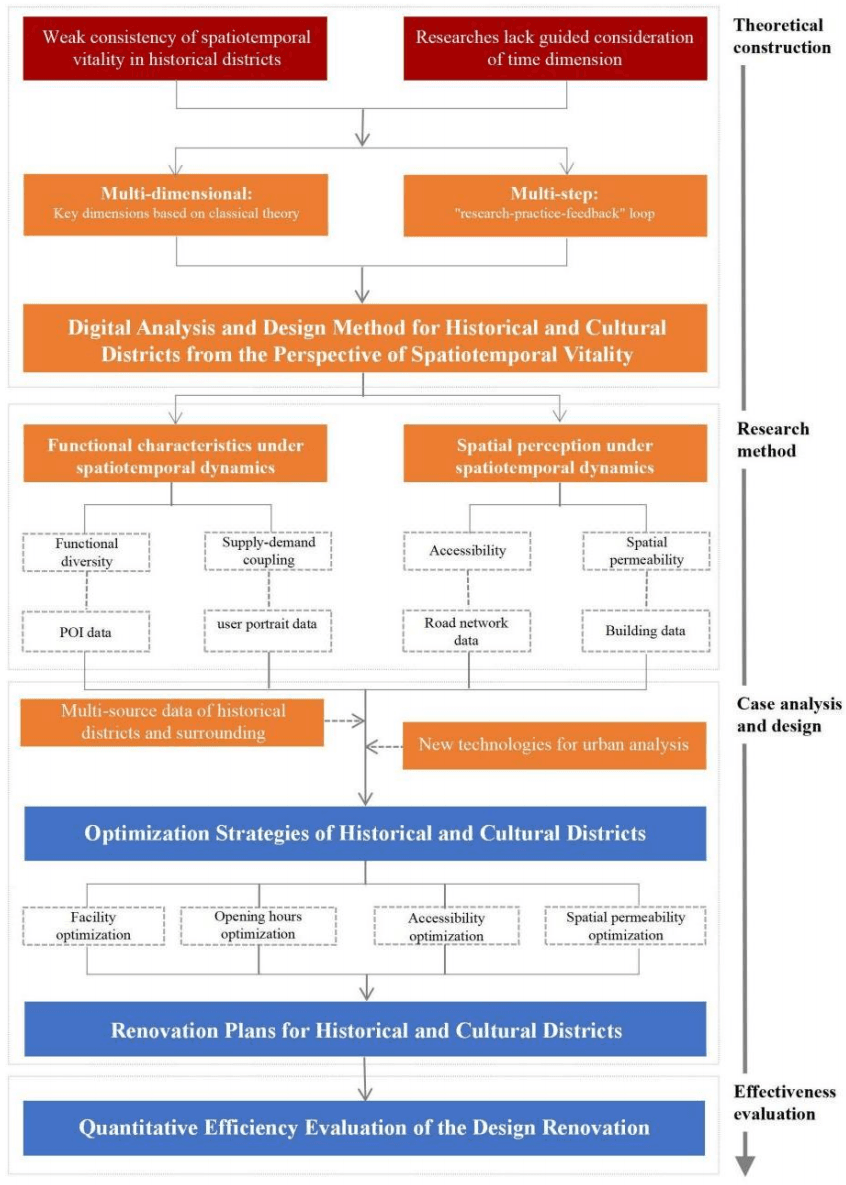
The protection and renewal of historical and cultural districts are receiving increasing attention. Nevertheless, many districts experience substantial gaps in vitality between day and night, while existing research rarely considers vitality assessment across multiple temporal dimensions. In response, this study proposes a digital analysis and design method for historical and cultural districts from the perspective of spatiotemporal vitality. Key evaluation dimensions are extracted by integrating classic theories of urban design and spatial vitality, then quantitatively analyzed to identify areas with insufficient vitality and support targeted strategies and design. Multi-source data make it possible to assess the continuation of spatiotemporal vitality and the enhancement of spatial richness. The study explores relationships among spatial vitality, functional characteristics, and spatial perception under spatiotemporal dynamics. It establishes a method for evaluating design effectiveness and provides embedded support from baseline analysis through design intervention and post-design evaluation.
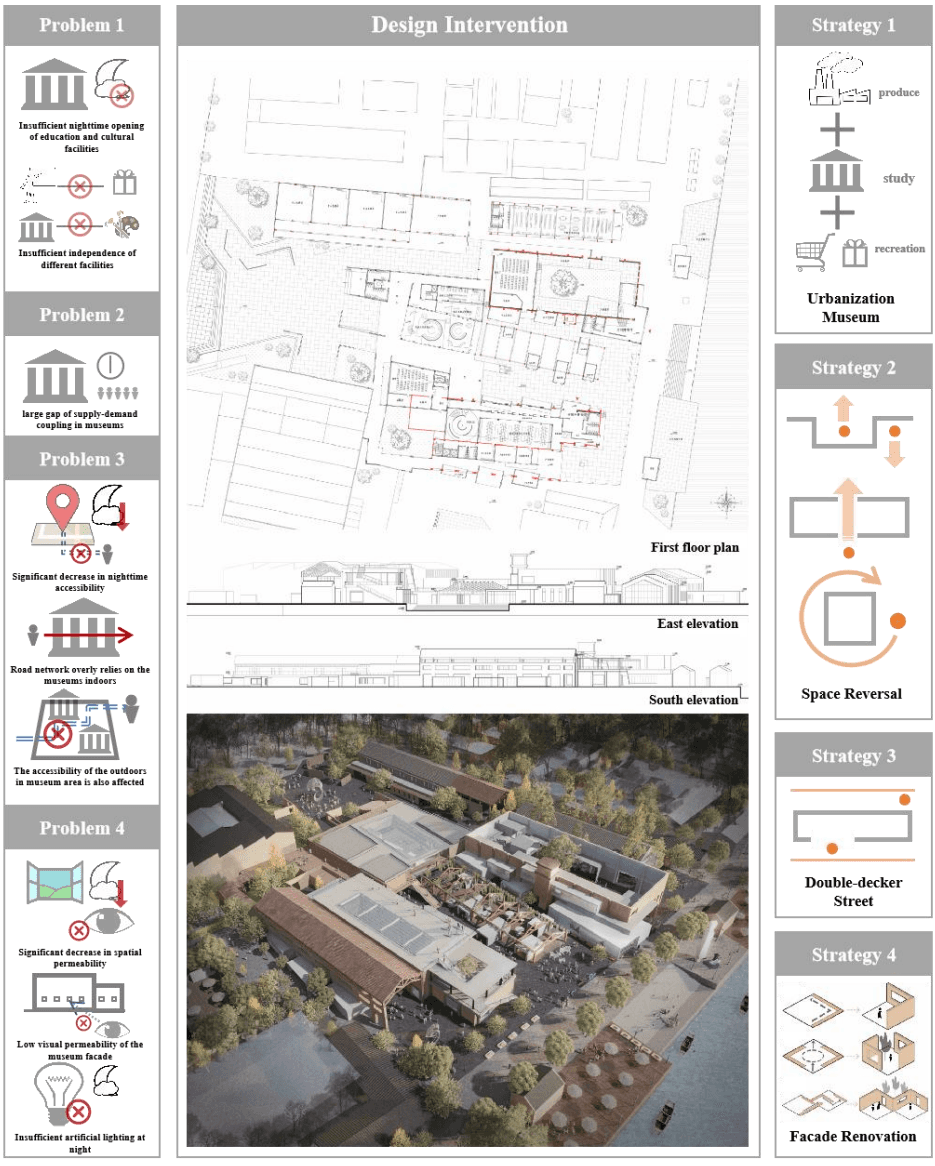
Design intervention strategies respond to time-specific facility, access, and permeability gaps.
Current Outcomes
Research, translation, and recognition.
Publication
- (EI) Chen Z. & Liu Y. (2026). Digital Analysis and Design for Historical and Cultural Districts from the Perspective of Spatiotemporal Vitality: Using Hangzhou Qiaoxi District as the Case. In Conference of Computational Design Professional Committee (pp. 181–208). Singapore: Springer Nature Singapore. DOI: 10.1007/978-981-95-0974-4_14.
Invention Patent
- Ye Y., Wu J., Chen Z. A method and system for evaluating the integrity of the historic urban area landscape based on deep learning. Invention Patent, China, Patent No. 202411437423.X, 2026.
Conference
- 2024 Academic Conference of Computational Design (CDAC), Shanghai, China, November 2024. Oral presentation: Digital Analysis and Design for Historical and Cultural Districts from the Perspective of Spatiotemporal Vitality.
- Presented the paper and received the CDAC 2024 Best Paper Award as first author.
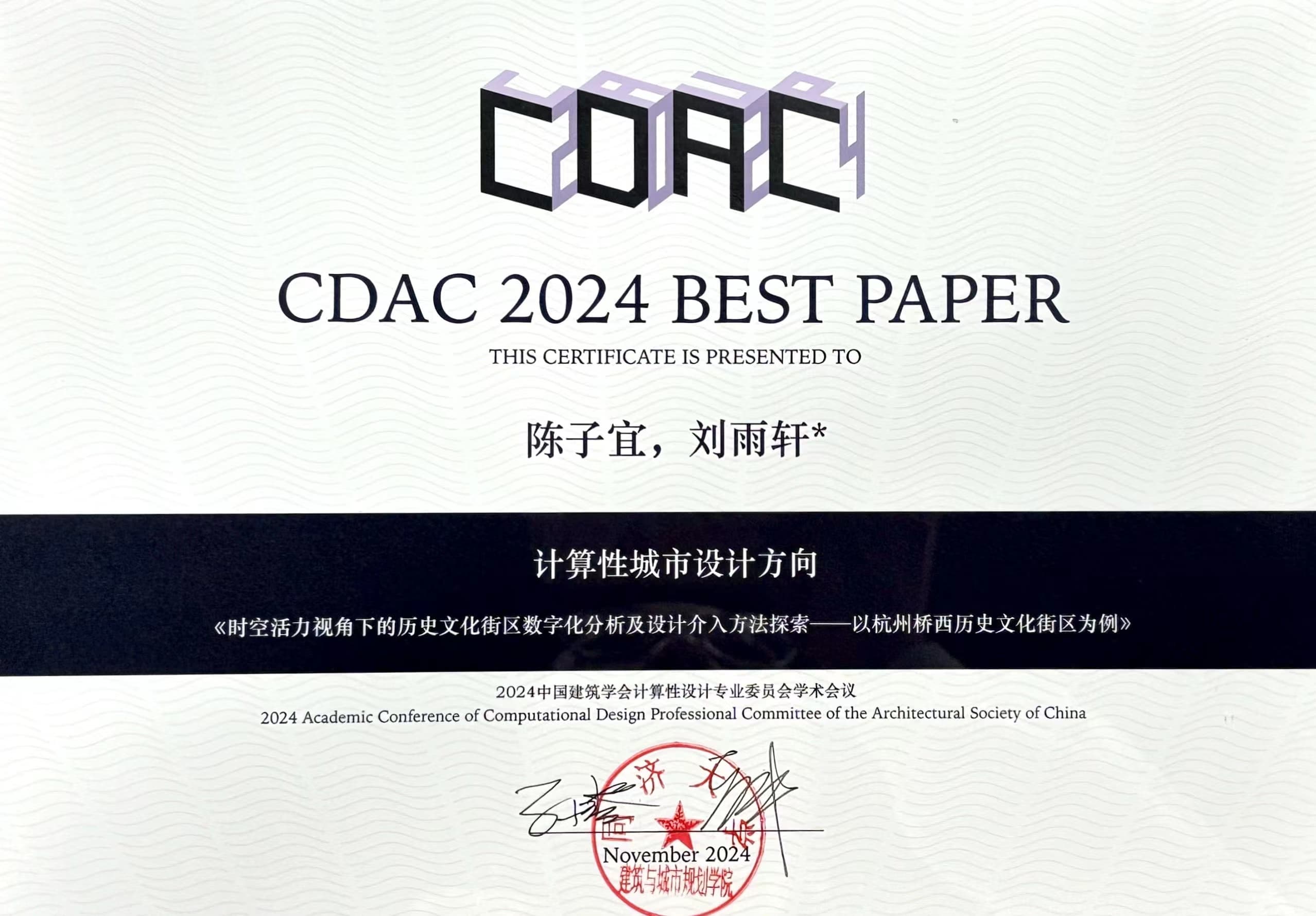
Best Paper Award at the 2024 Academic Conference of Computational Design (first author).