Measuring Sense of Place Continuity in Traditional Townscape through Machine Learning: An AI-Enhanced Method for Water-Town Heritage
How can LLMs and VLMs interpret complex spatial environments and human cognition?
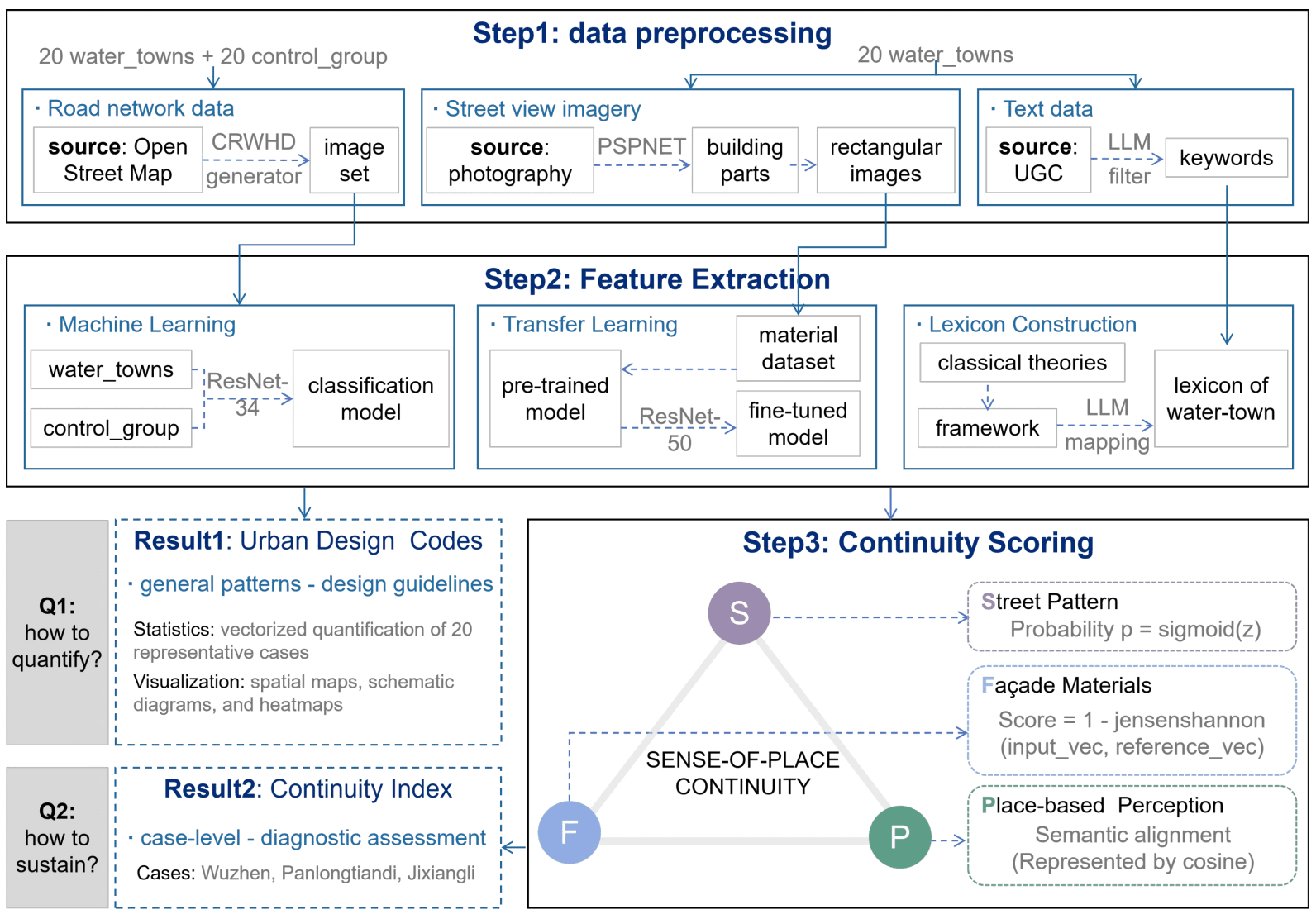
Abstract
This study proposes a multidimensional framework for measuring sense of place continuity in traditional settlements—a quality defined as the persistence of place-identity cues that enable recognition and meaning-making amid urban transformation. Under rapid urbanization, sense of place in traditional townscapes is increasingly at risk of erosion. As a form of living heritage, it plays a vital role in sustaining social interaction and cultural memory. By leveraging machine-learning algorithms with large language models, the study develops an AI-enhanced methodology to advance the computational understanding of place, enabling both diagnosis of current conditions and evaluation of continuity. Jiangnan water towns were selected as the study area because of their strong place identity. The framework uses multi-source urban data and Python-based tools to extract spatial, visual, and semantic features through deep convolutional models and natural-language-processing techniques. These features are compared with reference profiles derived from preserved environments to assess continuity. The study offers a novel pathway for quantifying previously intangible qualities, supports data-informed urban design and assessment, and shifts the discussion of authenticity from formal imitation toward continuity rooted in local context and lived experience.
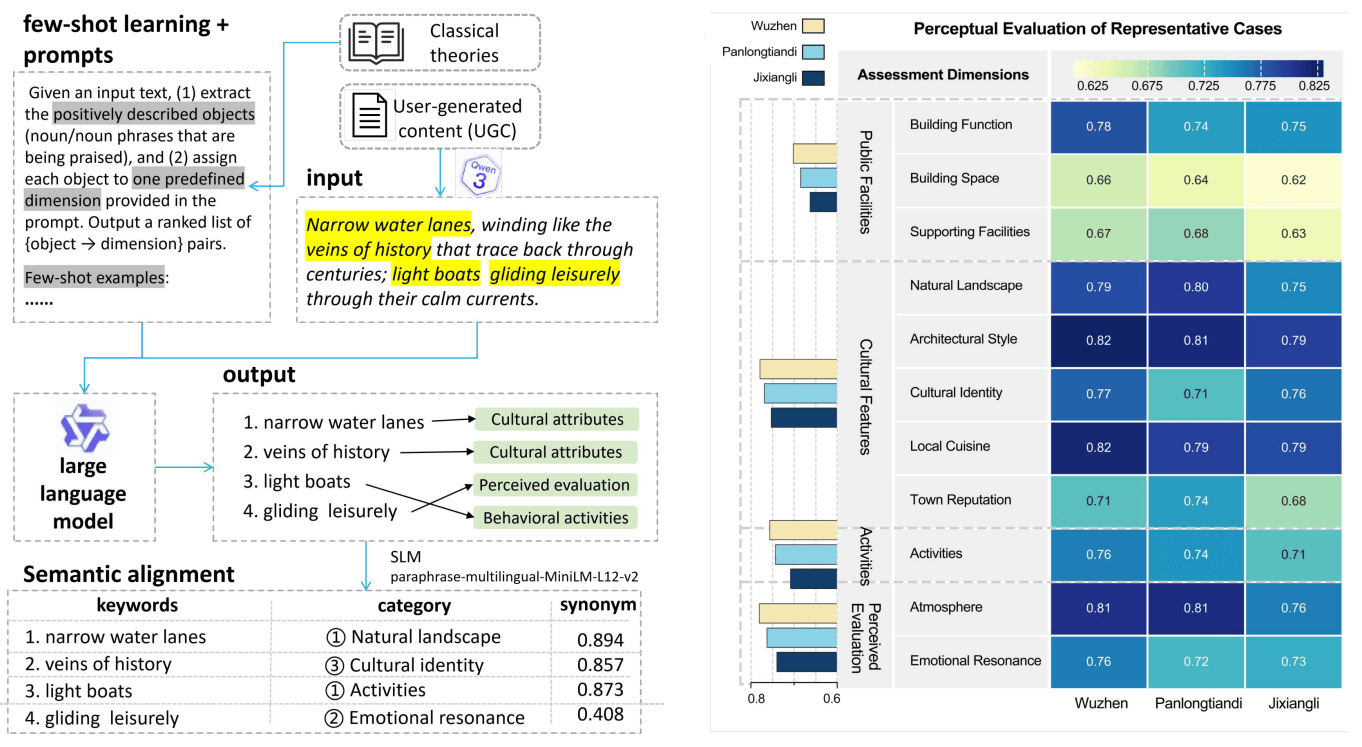
Large-language-model semantic alignment supports comparative perceptual evaluation.
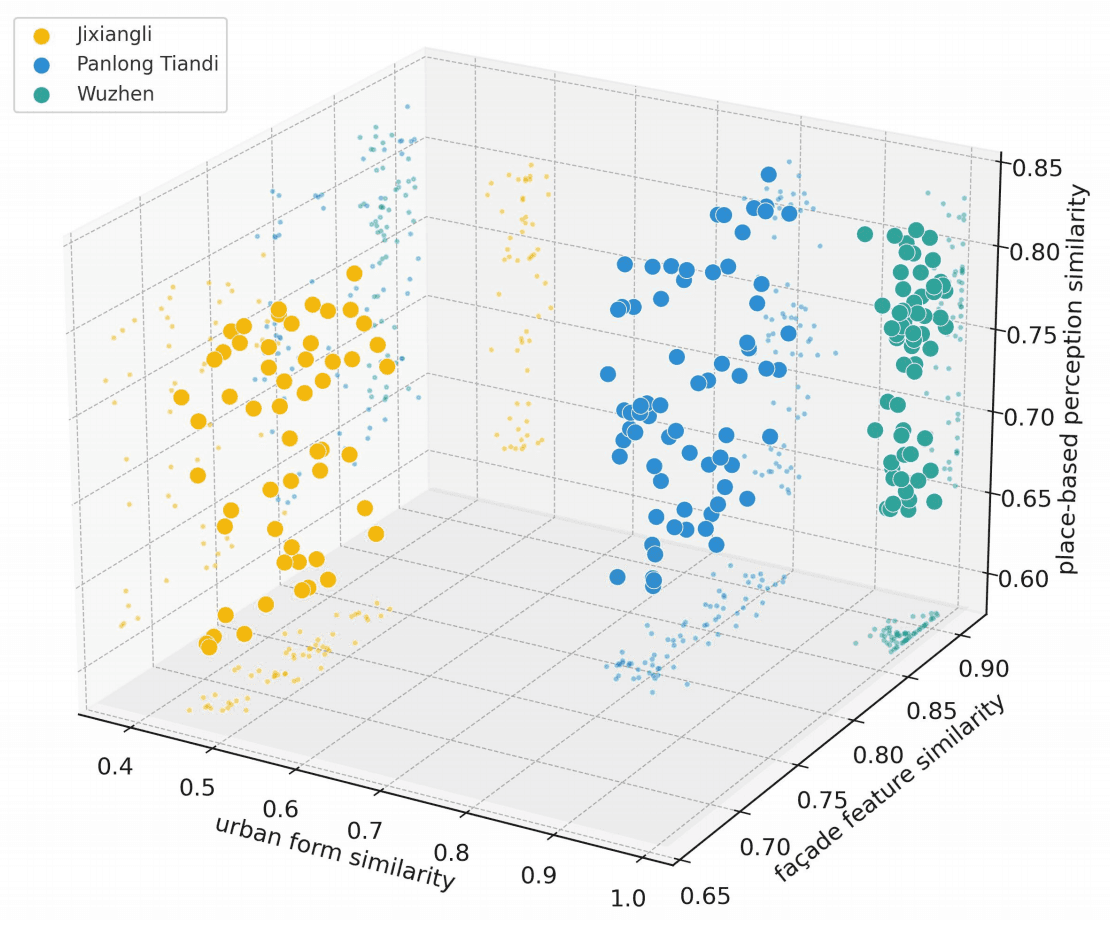
Urban form, façade features, and place-based perception are combined in a multidimensional continuity space.
Current Outcomes
Research, translation, and recognition.
Publication
- (SSCI-1) Lei J., Chen Z., Ye Y., et al. (2026). Measuring Sense of Place Continuity in Traditional Townscape through Machine Learning: An AI-Enhanced Method for Water-Town Heritage. Humanities and Social Sciences Communications. DOI: 10.1057/s41599-026-08772-x.
Invention Patent
- Huang C., Ye Y., Chen Z., et al. A full-process design method for distinctive townscapes featuring knowledge enhancement and 2D–3D linkage. Invention Patent, China, Patent No. 202610360281.4, 2026.